Adoro Te Devote
— Eucharistic hymn composed by Thomas Aquinas
Hidden God, devoutly I adore you, truly present underneath these veils; all my heart subdues itself before you, since it all before you faints and fails. Not to sight, or taste, or touch be credit, hearing only do we trust secure; I believe, for God the Son has said it — Word of Truth that ever shall endure.
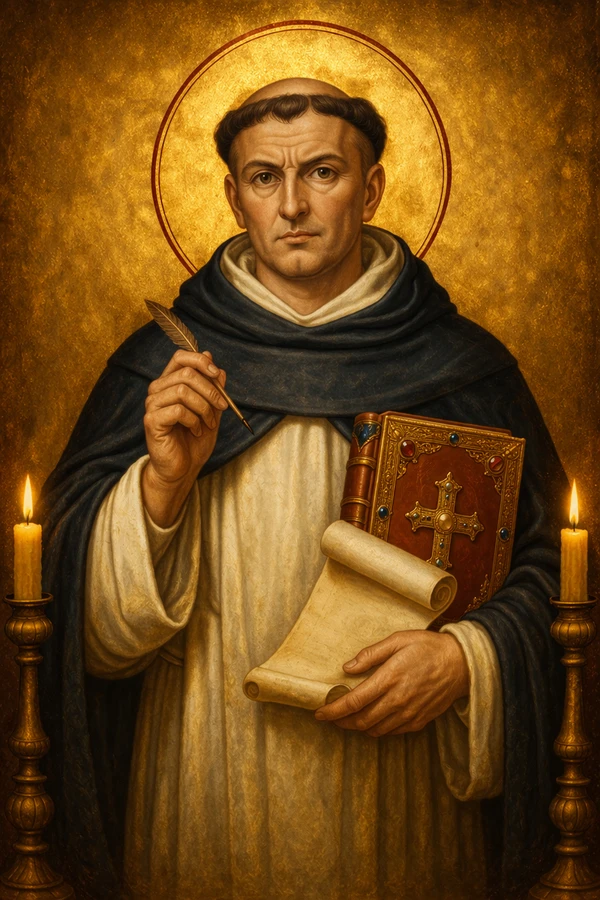
Thomas Aquinas
Biography, major works, and key teachings
Thomas Aquinas was the greatest systematic theologian in the history of Christianity — a Dominican friar whose Summa Theologiae became the definitive synthesis of faith and reason in the Western tradition.
Biography
About
Thomas Aquinas was the greatest systematic theologian in the history of Christianity — a Dominican friar whose Summa Theologiae became the definitive synthesis of faith and reason in the Western tradition.
Life
Born in 1225 at Roccasecca, near Naples, to a noble family that intended him for a prestigious abbacy, Thomas instead joined the Dominican order at eighteen — a choice his family resisted so fiercely that they kidnapped and imprisoned him for a year. After his release he studied under Albert the Great in Cologne and then in Paris, where he became a master of theology. He spent the rest of his life teaching, writing, and preaching — producing an almost inconceivable volume of work. The Summa Theologiae alone runs to nearly two million words. He wrote commentaries on Aristotle, on Scripture, and on Pseudo-Dionysius. He composed eucharistic hymns still sung today. In December 1273, during Mass, he experienced something that caused him to stop writing entirely. When pressed by his secretary, he said: 'Everything I have written seems like straw compared to what has now been revealed to me.' He died three months later, at forty-nine, on his way to the Second Council of Lyon.
Theological Vision
Aquinas held that faith and reason are not opponents but complementary paths to truth — reason can demonstrate that God exists, but revelation is needed to know who God is. His theology is structured by the conviction that all things come from God and return to God: the Summa moves from God's nature and the act of creation through the moral life and the person of Christ to the sacraments that draw creation back to its source. His proofs for God's existence (the Five Ways) remain the most discussed arguments in the philosophy of religion. His account of analogy — that human language about God is neither univocal nor equivocal but analogical — provides the philosophical framework that makes theology possible without reducing God to a concept. Yet Thomas was also a mystic: his eucharistic hymns (Pange Lingua, Tantum Ergo, Adoro Te Devote) express a devotional intensity that his systematic prose rarely reveals, and his final silence before the mystery he could no longer capture in words is perhaps his most profound theological statement.
Influence
Aquinas was declared a Doctor of the Church in 1567 and has been the preeminent theological authority in Roman Catholicism ever since. His synthesis of Aristotelian philosophy and Christian revelation shaped the entire subsequent history of Western theology. The Summa Theologiae remains the single most influential work of systematic theology ever written. His influence extends well beyond theology into philosophy of mind, ethics, metaphysics, and political theory.
Major Works
The most influential work of systematic theology ever written — nearly two million words organized in three parts covering God's nature and existence, the moral life and the virtues, and the person of Christ and the sacraments. Aquinas structured the work as a series of questions, each divided into articles that present objections, a counter-argument, a response, and replies to each objection. The format is scholastic, but the content ranges from the most abstract metaphysics (the simplicity of God, the nature of being) to the most practical ethics (justice, temperance, the morality of specific acts). Aquinas left the Summa unfinished after his mystical experience in December 1273 — the final section on the sacraments was completed by his students from his earlier writings. The work remains the standard reference in Catholic theology.
Aquinas's other great synthesis — written for a different audience than the Summa Theologiae. Where the Summa Theologiae assumes a Christian reader, the Contra Gentiles addresses those who do not share the premises of faith. The first three books argue from reason alone for God's existence, nature, and providence. The fourth book turns to truths accessible only through revelation: the Trinity, the Incarnation, the sacraments. The work is more argumentative and philosophical than the Summa Theologiae, and it remains one of the finest examples of natural theology in the Western tradition.
Commentary on the Gospel of John
Aquinas's most sustained engagement with the Johannine tradition — a verse-by-verse commentary that draws on the full resources of patristic exegesis and scholastic philosophy. The prologue commentary alone, on the Logos theology of John 1:1–18, is one of the richest treatments of the Word in Christian theology and connects directly to the Logos tradition that runs through this site.
A eucharistic hymn composed by Aquinas, probably for the Feast of Corpus Christi. In seven stanzas of extraordinary compression, the hymn moves from the hiddenness of God in the sacrament through the insufficiency of the senses to the act of faith that sees what the senses cannot. The final stanza's prayer — to see God face to face — connects the sacramental life to the beatific vision. The Adoro Te reveals the mystic behind the systematizer: Aquinas on his knees before the mystery his Summa could never exhaust.
Quotes
Selected passages drawn from the writings of Thomas Aquinas.
To one who has faith, no explanation is necessary. To one without faith, no explanation is possible.
Attributed
Everything I have written seems like straw compared to what has now been revealed to me.
Reported by Reginald of Piperno
The things that we love tell us what we are.
Attributed
The soul is like a field; the seed of divine knowledge is within it, but it cannot grow without the rain of grace.
Summa Contra Gentiles — III.53 (adapted)