On Prayer
— The Ladder of Divine Ascent, Step 28
Prayer is the mother and daughter of tears. It is an expiation of sin, a bridge across temptation, a bulwark against affliction. It wipes out conflict, is the work of angels, and is the nourishment of everything spiritual.
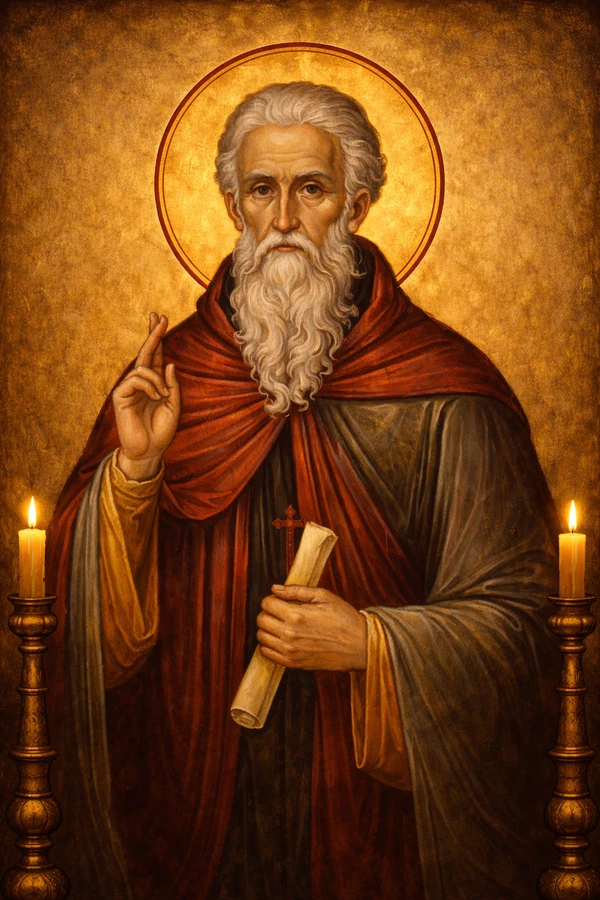
John Climacus
Biography, major works, and key teachings
John Climacus was a monk of Mount Sinai whose Ladder of Divine Ascent became the most widely used handbook of the spiritual life in the Eastern Christian tradition.
Biography
About
John Climacus was a monk of Mount Sinai whose Ladder of Divine Ascent became the most widely used handbook of the spiritual life in the Eastern Christian tradition.
Life
Almost nothing is known of John's origins. He came to the monastery at Mount Sinai — now Saint Catherine's Monastery — at about sixteen and placed himself under the direction of an elder named Martyrius. After Martyrius's death, John withdrew to a hermitage at the foot of the mountain, where he lived in solitude for roughly forty years — praying, fasting, studying the writings of the Fathers, and receiving visitors who sought his counsel. His reputation for holiness and spiritual wisdom spread far beyond Sinai. At about seventy-five he was persuaded to become abbot of the monastery, a position he held for only four years before returning to solitude. During his time as abbot, at the request of John, the abbot of the nearby Raithu monastery, he composed The Ladder of Divine Ascent — the work that gave him his name (Climacus, from the Greek klimax, 'ladder'). He died around 649.
Theological Vision
The Ladder is structured as thirty steps — corresponding to the thirty years of Christ's hidden life — ascending from renunciation of the world to the summit of love. The early steps address the passions: anger, sloth, gluttony, lust, pride. The middle steps treat the active virtues: obedience, humility, discernment, stillness. The final steps open onto the contemplative life: prayer, dispassion (apatheia), and love (agape), which crowns the entire ascent. John's method is not systematic philosophy but practical wisdom distilled from decades of monastic experience. He writes in short, sharp sentences — pithy definitions, paradoxical aphorisms, and vivid anecdotes drawn from the desert tradition. The Ladder insists that the spiritual life is a real ascent that requires real effort, genuine suffering, and the willingness to be honest about one's own failures. Yet the final rung is not achievement but love — the gift that makes all the preceding labor meaningful.
Influence
The Ladder of Divine Ascent became one of the most widely read books in the Byzantine world, translated into Latin, Syriac, Arabic, Armenian, and Old Slavonic. It is still read aloud in Orthodox monasteries during Great Lent. The famous icon of the Ladder — showing monks climbing while demons try to drag them down — is one of the most recognizable images in Eastern Christian art. John is commemorated on the Fourth Sunday of Great Lent in the Orthodox Church.
Major Works
The most widely read handbook of the spiritual life in the Eastern Christian tradition, composed around 600 AD at the monastery on Mount Sinai. The Ladder presents the ascetical life as thirty steps — corresponding to the thirty hidden years of Christ's life — ascending from renunciation of the world to the summit of love. The early steps confront the passions with unflinching honesty; the middle steps cultivate the active virtues; the final steps open onto prayer, stillness, and dispassion. John writes in short, paradoxical sentences that function like spiritual grenades — each one designed to detonate a comfortable assumption. The work is demanding and occasionally severe, but its final rung is not achievement but agape: love that crowns and completes every preceding effort. The famous Ladder icon, showing monks climbing while demons drag them down, has made this text's imagery part of the visual vocabulary of Eastern Christianity.
A companion work to the Ladder, addressed to the abbot of a monastery rather than to the monks. Where the Ladder describes the individual's ascent, To the Shepherd describes the responsibilities of the one who guides others on that ascent. It is shorter and less well known than the Ladder but offers a remarkable portrait of spiritual authority exercised through gentleness, discernment, and prayer.
Quotes
Selected passages drawn from the writings of John Climacus.
The growth of fear is the starting point of love, and total purity is the founding of theology.
The Ladder of Divine Ascent — Step 30
Ascend, my brothers, ascend eagerly. Let your hearts resolve to the climb.
The Ladder of Divine Ascent — Step 30 (conclusion)
Do not be surprised that you fall every day; do not give up, but stand your ground courageously. And assuredly the angel who guards you will honor your patience.
The Ladder of Divine Ascent — Step 26
The beginning of stillness is the putting away of distraction. The middle of stillness is an illuminated heart. The end of stillness is standing before God.
The Ladder of Divine Ascent — Step 27