From the Paschal Homily
— Paschal Homily of Saint John Chrysostom
Let no one fear death, for the Savior's death has set us free. He who was held prisoner of it has annihilated it. By descending into hell, he made hell captive. He embittered it when it tasted of his flesh. Christ is risen, and you, O death, are annihilated. Christ is risen, and the evil ones are cast down. Christ is risen, and the angels rejoice. Christ is risen, and life is liberated.
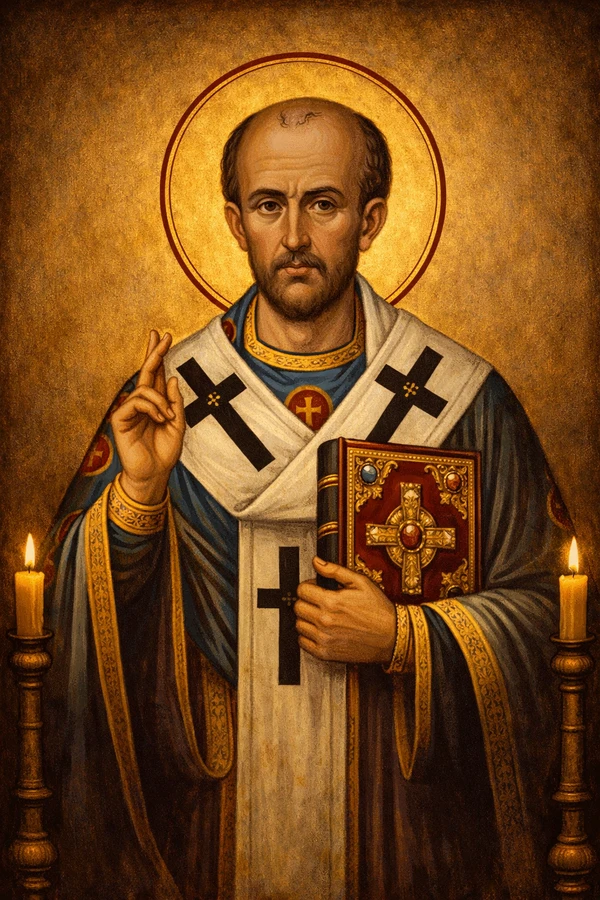
John Chrysostom
Biography, major works, and key teachings
John Chrysostom — 'Golden Mouth' — was the greatest preacher in the history of the Eastern Church, a bishop whose homilies on Scripture combined moral passion with literary brilliance and cost him everything.
Biography
About
John Chrysostom — 'Golden Mouth' — was the greatest preacher in the history of the Eastern Church, a bishop whose homilies on Scripture combined moral passion with literary brilliance and cost him everything.
Life
Born around 349 in Antioch to a Christian family, John studied rhetoric under the famous pagan orator Libanius, who reportedly said that John would have been his successor 'if the Christians had not stolen him.' After years as a monk and hermit in the mountains near Antioch — austerities that permanently damaged his health — he was ordained a priest and became the most celebrated preacher in the East. In 397, against his will, he was made Archbishop of Constantinople. There his reforming zeal and fearless criticism of luxury — including that of the empress Eudoxia — earned him powerful enemies. He was deposed, exiled, briefly recalled, and exiled again. He died on a forced march in 407, his last words reportedly being 'Glory to God for all things.' He was declared a Doctor of the Church and is one of the Three Holy Hierarchs in the Orthodox tradition.
Theological Vision
Chrysostom's theology is rooted in Scripture and oriented toward practice. His hundreds of homilies — on Genesis, the Psalms, Matthew, John, Romans, and nearly every Pauline epistle — are the most extensive body of biblical preaching from the ancient Church. He read Scripture with the Antiochene attention to the literal and historical sense, but his purpose was always pastoral: to move his congregation from hearing to action. His moral theology is fiercely practical and socially radical. He denounced wealth hoarded while others starve, insisted that the Eucharist is meaningless if the poor go unfed, and argued that the Church's altar extends to the streets where the homeless lie. His liturgical contributions survive in the Divine Liturgy of Saint John Chrysostom, the most commonly celebrated liturgy in the Orthodox Church.
Influence
Chrysostom is the most quoted Church Father in Eastern Christianity. His homilies set the standard for biblical preaching and remain in regular use. His social teaching — particularly his insistence that charity is not optional but a matter of justice — speaks directly to every era. His Paschal Homily, read every Easter in Orthodox churches worldwide, is among the most beloved texts in the Christian tradition.
Major Works
Homilies on the Gospel of Matthew
Ninety homilies covering the entire Gospel of Matthew — the most extensive patristic commentary on any single Gospel. Chrysostom reads Matthew with the Antiochene attention to the literal sense but always drives toward moral application. His treatment of the Sermon on the Mount is particularly powerful: he insists that Christ's teaching is not an impossible ideal but a genuine command, and he holds his wealthy Constantinopolitan congregation to account with a directness that made him dangerous to the powerful.
Homilies on the Epistle to the Romans
Thirty-two homilies on Paul's most theologically dense letter. Chrysostom reads Romans as a practical text about the transformation of the believer's life, not merely a doctrinal treatise on justification. His treatment of Romans 12–15 — the ethical implications of grace — is among the finest pastoral commentary in the tradition.
A dialogue in six books on the nature and demands of pastoral ministry, written early in Chrysostom's career. The work is both a theology of priesthood and a meditation on the terrifying responsibility of caring for souls. Chrysostom's central argument is that the pastoral office demands greater virtue than the monastic life, because the priest must sanctify not only himself but others — a task requiring wisdom, patience, and a courage that Chrysostom clearly felt as a personal burden.
The most beloved single text in the Orthodox liturgical tradition, read aloud at every Easter service. In a sustained crescendo of joy, Chrysostom proclaims the total victory of Christ over death, hell, and corruption. The homily invites everyone — those who fasted and those who did not, those who arrived early and those who came at the eleventh hour — to the feast of the Resurrection. Its closing lines — 'Christ is risen, and not one dead remains in the grave' — have been spoken in every Orthodox church in the world for over fifteen centuries.
Quotes
Selected passages drawn from the writings of John Chrysostom.
Do you wish to honor the Body of Christ? Do not ignore him when he is naked. Do not honor him here in the church with silk fabrics while neglecting him outside where he is cold and naked.
Homilies on Matthew — Homily 50.3
This is the rule of the most perfect Christianity, its most exact definition, its highest point: to seek what is for the benefit of all.
Homilies on 1 Corinthians — Homily 25.3
Prayer is the mother and daughter of tears. It is an expiation of sin, a bridge across temptation, a bulwark against affliction.
Attributed / Liturgical tradition
The road to hell is paved with the skulls of bishops.
On the Priesthood — Attributed (widely circulated variant)
Not to share our own wealth with the poor is theft from the poor and deprivation of their means of life; we do not possess our own wealth but theirs.
Homilies on the Epistle to the Romans — Homily II on Lazarus (adapted)
If you cannot find Christ in the beggar at the church door, you will not find him in the chalice.
Homilies on Matthew — Homily 50 (adapted)