Prayer for Divine Illumination
— Adapted from Devotional synthesis from the Triads
O Lord, light inaccessible, who in your uncreated radiance revealed yourself on Tabor to your disciples: illuminate the eyes of my soul that I may behold your glory, not as essence hidden beyond all being, but as the energy of your love made present in the silence of the heart.
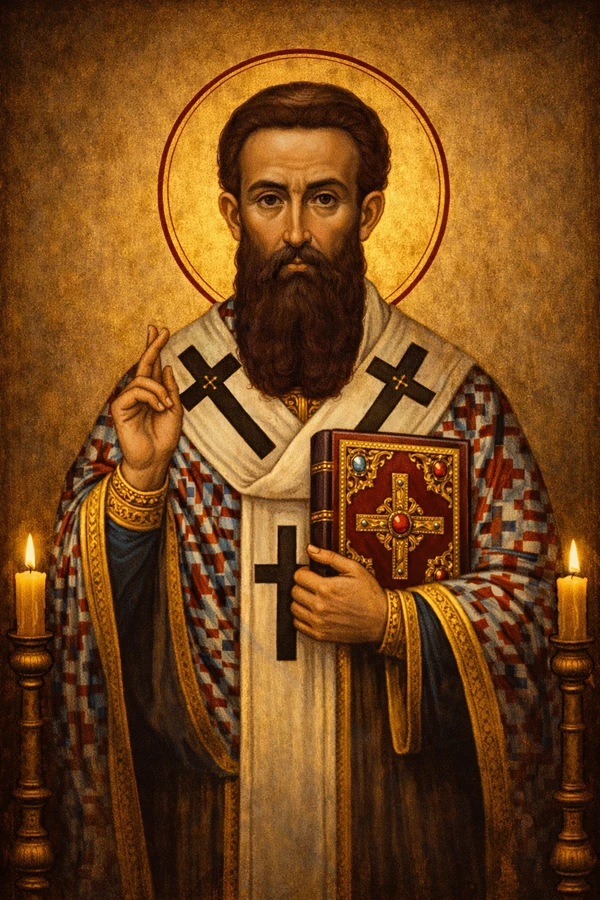
Gregory Palamas
Biography, major works, and key teachings
Gregory Palamas was the great theologian of hesychasm — the Eastern Christian tradition of interior prayer — whose distinction between God's essence and energies provided the philosophical framework for the claim that human beings can truly experience God.
Biography
About
Gregory Palamas was the great theologian of hesychasm — the Eastern Christian tradition of interior prayer — whose distinction between God's essence and energies provided the philosophical framework for the claim that human beings can truly experience God.
Life
Born in 1296 in Constantinople to a noble Anatolian family, Palamas received an excellent classical education but chose the monastic life, entering Mount Athos around 1318 along with his two brothers. He lived as a monk and later a hermit, practicing the hesychast method of prayer — the Jesus Prayer ('Lord Jesus Christ, Son of God, have mercy on me') combined with physical disciplines of breathing and posture aimed at concentrating the mind in the heart. When the Calabrian philosopher Barlaam attacked hesychasm as superstitious and uneducated, Palamas was called upon by his fellow Athonite monks to defend their way of life. The result was his masterwork, the Triads in Defense of the Holy Hesychasts. His theology was vindicated at councils in Constantinople in 1341, 1347, and 1351, though he was also imprisoned for a period during political upheavals. He was made Archbishop of Thessalonica in 1347 and died in 1359. He was canonized by the Orthodox Church in 1368.
Theological Vision
Palamas's central theological contribution is the distinction between God's essence (ousia) and God's energies (energeiai). God's essence — what God is in himself — remains absolutely transcendent, unknowable, and inaccessible to any creature, now or in eternity. But God's energies — his operations, his self-communication, his grace — are genuinely divine, uncreated, and truly shared with human beings. This distinction allowed Palamas to affirm two things simultaneously: that God is utterly beyond all human comprehension, and that the hesychast monks who claimed to experience God's presence in prayer were telling the truth. The light they experienced — which Palamas identified with the light that shone on Mount Tabor at Christ's Transfiguration — was not a created symbol or a psychological projection but the uncreated energy of God himself. This theology completed a trajectory that runs from the Cappadocians through Maximus the Confessor: God is truly unknowable in essence, truly experienced in energies.
Influence
Palamas's theology was formally adopted by the Orthodox Church at the councils of 1341 and 1351, which many Orthodox theologians regard as having ecumenical authority. His essence-energies distinction became the foundation of Orthodox mystical theology and provides the philosophical underpinning for the entire Eastern Christian understanding of theosis — participation in the divine life. He is commemorated on the Second Sunday of Great Lent, and his feast marks the Orthodox Church's affirmation that God is not only to be believed in but genuinely encountered.
Major Works
Triads in Defense of the Holy Hesychasts
Palamas's masterwork — nine treatises organized as three sets of three, written between 1338 and 1341 in response to the philosopher Barlaam's attacks on the hesychast monks of Mount Athos. Barlaam denied that the monks could genuinely experience God; Palamas responded with a comprehensive theology of divine self-communication. The central argument: God's essence remains absolutely unknowable, but God's uncreated energies — his love, his light, his grace — are genuinely divine and genuinely experienced by those who pray. The Triads are dense and polemical, but their underlying question is one of the most important in all theology: can God truly be encountered, or is all religious experience merely human projection? Palamas's answer — that the light of Tabor was uncreated, divine, and real — became the official teaching of the Orthodox Church.
A declaration drafted by Palamas in 1341 with the support of the monastic communities of Mount Athos, affirming the hesychast teaching on the uncreated light and the real possibility of experiencing God in prayer. The Tome served as the theological platform for the councils that vindicated Palamas's position.
A collection of homilies delivered during Palamas's time as Archbishop of Thessalonica, covering liturgical feasts, the Transfiguration, the Virgin Mary, and the spiritual life. These homilies are more accessible than the Triads and reveal Palamas as a pastor as well as a polemicist — a preacher who wanted his congregation to understand that the God they worshipped in the liturgy could be genuinely encountered in the silence of the heart.
Quotes
Selected passages drawn from the writings of Gregory Palamas.
God is not only beyond knowledge, but also beyond unknowing.
Triads in Defense of the Holy Hesychasts — Triads II.3.49
Those who engage in spiritual struggle according to the inner man find the grace of the Spirit coming to them as fire, illuminating them and making them like burning candles.
Homilies — Homily 35 (adapted)