From On the Incarnation
— Adapted from Devotional synthesis from On the Incarnation
O Word of the Father, who took upon yourself our nature that we might be made partakers of your divinity: grant that we who confess you as true God may know the power of your resurrection and the fellowship of your life.
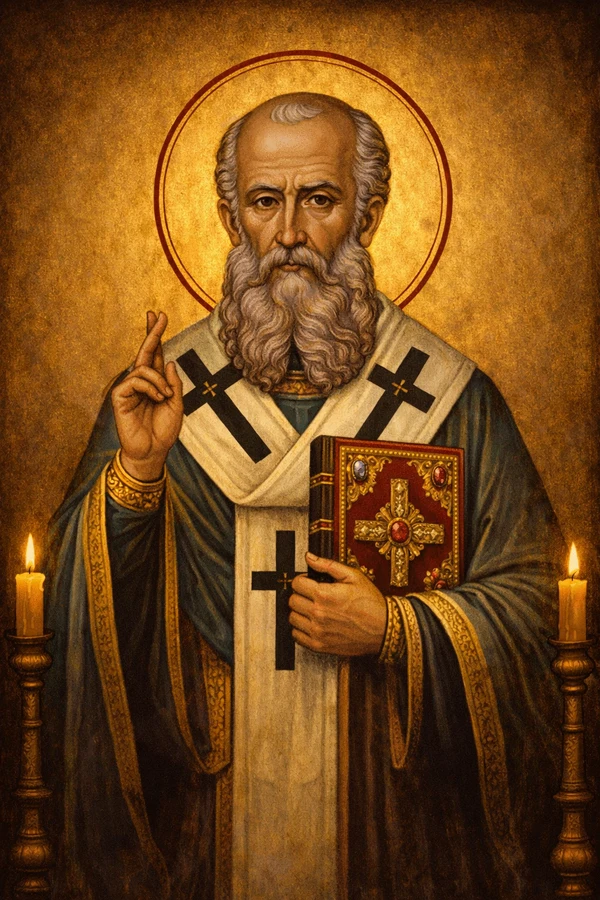
Athanasius of Alexandria
Biography, major works, and key teachings
Athanasius of Alexandria was the most tenacious defender of Nicene orthodoxy in the fourth century — a bishop who was exiled five times by four different emperors and never once abandoned his insistence that the Son is fully God.
Biography
About
Athanasius of Alexandria was the most tenacious defender of Nicene orthodoxy in the fourth century — a bishop who was exiled five times by four different emperors and never once abandoned his insistence that the Son is fully God.
Life
Born around 296 in Alexandria, Athanasius was educated in the city's renowned catechetical tradition and served as secretary to Bishop Alexander. He attended the Council of Nicaea in 325 as a young deacon and played a role in shaping its declaration that the Son is homoousios — of the same essence — with the Father. He became bishop of Alexandria in 328, at roughly thirty years of age, and held the position for forty-five years, though seventeen of those were spent in exile. He was banished to Trier, to Rome, to the Egyptian desert, and to the outskirts of his own city — driven out by Arian emperors, hostile bishops, and imperial politics. Each time he returned. Jerome's famous summary of the era — 'the whole world groaned and was amazed to find itself Arian' — captures the scale of what Athanasius faced. He died in 373, having outlasted every emperor who opposed him.
Theological Vision
Athanasius's theology is driven by a single soteriological conviction: only God can save. If the Son is a creature — however exalted — then the Incarnation is not God entering human life but merely another creature doing so, and salvation becomes impossible. On the Incarnation, written before the Arian crisis had fully erupted, already articulates this logic with remarkable clarity: the Word became flesh so that we might be made divine. This exchange — God becoming human so that humans might share in divine life — is the golden thread of Athanasius's entire theology. His Orations Against the Arians systematically demolished every argument for the Son's subordination, insisting that the biblical language of begetting, sending, and obedience describes the economy of salvation, not a hierarchy within God. He also championed the divinity of the Holy Spirit in his Letters to Serapion, extending the Nicene logic to its necessary conclusion.
Influence
Athanasius earned the title 'Father of Orthodoxy' and the epithet Athanasius contra mundum — Athanasius against the world. His Life of Antony, a biography of the desert monk, became one of the most widely read texts in early Christianity and effectively invented the genre of hagiography. His theological legacy is the Nicene faith itself: the confession that the Son is 'God from God, Light from Light, true God from true God' owes its survival in large part to his refusal to yield.
Major Works
The first great systematic defense of the Incarnation in Christian theology, written before Athanasius was thirty. The argument is breathtakingly simple: humanity was created in the image of God but fell into corruption and death. No creature could reverse this; only the Creator could restore what he had made. Therefore the Word — through whom all things were made — took on human flesh, lived a human life, and died a human death, so that in his resurrection humanity might be raised to the divine life it was always meant to share. C.S. Lewis, who wrote the introduction to a popular English edition, called it 'a masterpiece' and recommended it as the first book any Christian should read after the New Testament. The work is short, luminous, and as radical today as when it was written: God became human so that humans might become God.
Athanasius's most sustained theological polemic — three (possibly four) orations systematically demolishing every argument for the Son's subordination to the Father. Written during exile, these orations are not academic exercises but urgent defenses of the faith Athanasius believed was necessary for salvation. If the Son is a creature, then God has not truly entered human life, and salvation is an illusion. The reasoning is relentless, the biblical exegesis detailed, and the conviction absolute.
A biography of Antony the Great, the father of Christian monasticism, written by Athanasius shortly after Antony's death. The work effectively invented the genre of hagiography and became one of the most widely read texts in the ancient Church. Augustine's conversion was partly catalyzed by hearing the story of two men who read the Life of Antony and immediately abandoned their careers. The text presents the monastic life as spiritual combat — Antony wrestling with demons in the desert — and offers a vision of holiness that is both terrifying and magnetic.
Four letters addressed to Bishop Serapion of Thmuis defending the full divinity of the Holy Spirit against those who accepted the divinity of the Son but denied it of the Spirit. Athanasius extends the same logic he used against the Arians: if the Spirit sanctifies, divinizes, and gives life, then the Spirit must be fully divine. These letters are among the earliest systematic treatments of the Holy Spirit's divinity in Christian theology.
Quotes
Selected passages drawn from the writings of Athanasius of Alexandria.
The Word was not diminished by receiving a body, but rather he deified what he put on.
On the Incarnation — 17
The whole world groaned and was amazed to find itself Arian.
History of the Arians — as reported by Jerome